

Leaked documents reveal cooperation between university administrations and private and government security firms to collect student data, transforming campuses into spaces governed by monitoring and repression rather than freedom of expression.
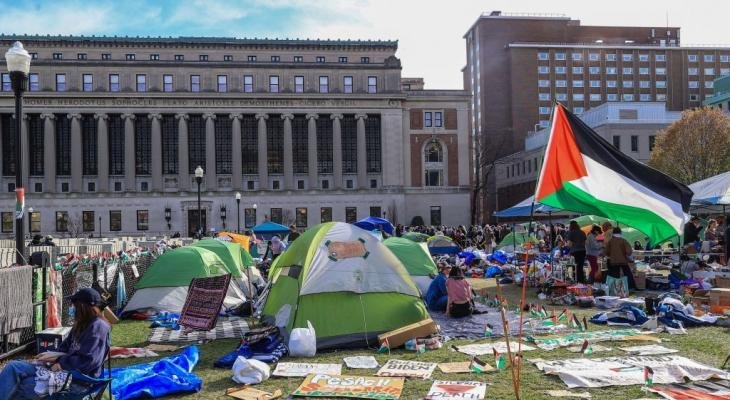
Since the beginning of the Israeli genocide on Gaza in October 2023, student voices across the United States have risen to demand an end to what they describe as genocide and to call on universities to stop investing in companies involved in military support. Students also demanded protection of free expression on campus. These protests did not remain isolated or confined to a single university. They spread to more than sixty campuses and placed thousands of students in direct confrontation with university administrations, police forces, and in many cases external organizations seeking to defame them.
The weight of the protests caused some universities to change from being places of free discussion to places dominated by fear, using administrative, digital, and technological tools to suppress pro-Palestine activism. The Intercept report released in November 2025 not only brought to light this trend with disturbing details but also proved that it was not an isolated case but the manifestation of a larger pattern of systematic repression.
What The Intercept revealed: a structured system of monitoring run by security companies
The investigative report published on 24 November presented internal documents and emails that show how several American universities relied on artificial intelligence systems and private companies to monitor students who support Palestine. At the University of Houston, the documents show that a Dataminr tool collected an enormous amount of student content and monitored semi closed Telegram channels, issuing thousands of alerts describing student activity as concerning.
These alerts were not symbolic or merely technical details. They were sent directly to administrative officials and influenced decisions on security measures and when to call the police. In another example, the University of Connecticut used a tool previously known as Social Sentinel to track posts and email accounts, which enabled campus police to access information about protest organizers and the internal atmosphere of student encampments.
What is alarming is that these tools do not only track public content. They also monitor semi private groups and share information with external law enforcement under the stated purpose of investigating incidents of antisemitism. The documents show that universities were not only collecting data but that some of them handed full student files to federal and government agencies, raising the risk of multiple forms of harmful use, including potential deportation, cutting financial support to institutions, or issuing accusations that could undermine students’ academic and professional futures.
Not the first time, but part of a wider history of repression
The Intercept’s findings are just the latest in a series of events going back to the spring of 2024 when there were massive demonstrations at many American universities. The encampment at Columbia University was among the most important events, and more than one hundred students were taken into custody in one day. Following this, the protest was also seen at Harvard, Yale, UCLA, Michigan, and other places.
University administrations responded with temporary suspensions, bans from academic facilities, and punitive actions taken without fair hearings. Many requests by students facing harassment and doxxing were ignored. In several cases, international students had their personal information posted online, alongside threats of being reported to immigration authorities, creating an atmosphere of fear among the most vulnerable groups, especially those on study visas or searching for work after graduation.
Reports also surfaced about the use of Fusion Centers, intelligence networks created after the attacks of 11 September to allow information sharing between law enforcement agencies. These networks have now been used to monitor activism related to Palestine. Although these buildings were earlier employed against the Black Lives Matter movement in 2020, recent occurrences indicate that the security apparatus has broadened its scope to include international solidarity movements that challenge certain political and financial interests inside and outside the university to their being targeted.
Doxxing campaigns and organized harassment
Another dark dimension of this trend is the targeted exposure of students through doxxing, in which personal information is published to smear activists and damage their futures. Several coordinated campaigns have been carried out by political and media groups allied with pressure networks that support Israeli policies.
These included advertising trucks displaying the names and photos of students at Harvard and Columbia, and archival websites such as Canary Mission, which has collected files on hundreds of activists for years, leading to travel restrictions and professional or legal consequences for many. In multiple cases, social media accounts demanded that security agencies investigate international students through ICE, placing some at risk of losing legal protection or facing deportation.
As a result, many students no longer feel able to participate freely in political discussions or organize events. Sharing an opinion can now provoke professional, legal, or even personal threats. These concerns are not exaggerated. There are documented cases of students who lost job opportunities, faced assaults, or lived with persistent psychological stress because of the scrutiny they faced on and off campus.
Universities face a moral test
The Intercept’s disclosures are tied to the broader picture by the aspect that students pay for these policies. Under every inquiry report, there are actual people who were deprived of opportunities, were not allowed to study in safe conditions, and had their lives and futures affected by threats. The psychological, social, and professional impacts of these practices are just as important as the legal and political ones. Nowadays, students live in a constant state of being monitored and feeling insecure, which restricts their participation in academics and weakens the core purpose of universities as places for open discussion and intellectual exchange.
Today, American universities stand before a fundamental moral test. Will higher education institutions protect the values of diversity and free expression, or will they continue to turn into instruments that serve external interests, whether private security firms or political actors?The answer will determine the development of university life and the destiny of a generation asking for justice and human rights. The universities’ duty during the Gaza war and the humanitarian crisis, which is getting worse, is obvious; they need to protect their students and not put them under surveillance, intimidation, and slander.
In conclusion, the revelations made by The Intercept and other investigations have now turned the issue into rights, procedures, and public ethics. This, in turn, has resulted in the demand for real accountability from the universities, government, and civil society. If you want, I can shorten this text into a press style or rewrite it in a more digital-friendly way with keywords and meta descriptions suggested.