

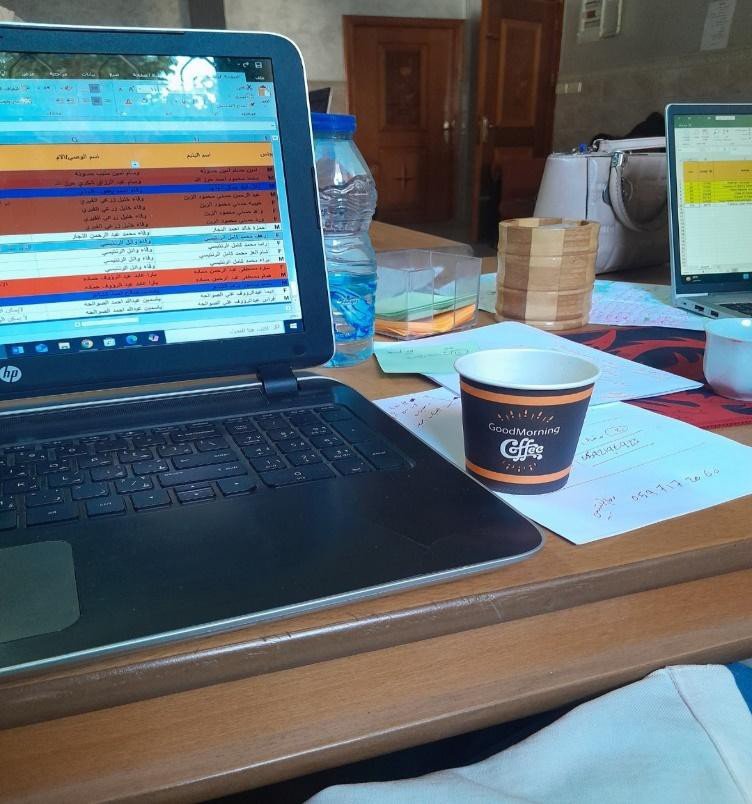
When I was accepted for this position, my first ever job, it was a big surprise. I had never done an interview before. “Why did you accept me? “ I asked the director, Abu Tarek. “I have no experience, and surely many others applied.”
He smiled and said, “We saw in you loyalty, presence, and the ability to learn.”
My name is Jumana Mughari. I am 23 years old—though some say 24. I refuse to grow older, so I hold on to 23. I live in Deir al-Balah, in central Gaza, and I work as a project coordinator at Dar Al-Sabeel Orphanage in Gaza City.
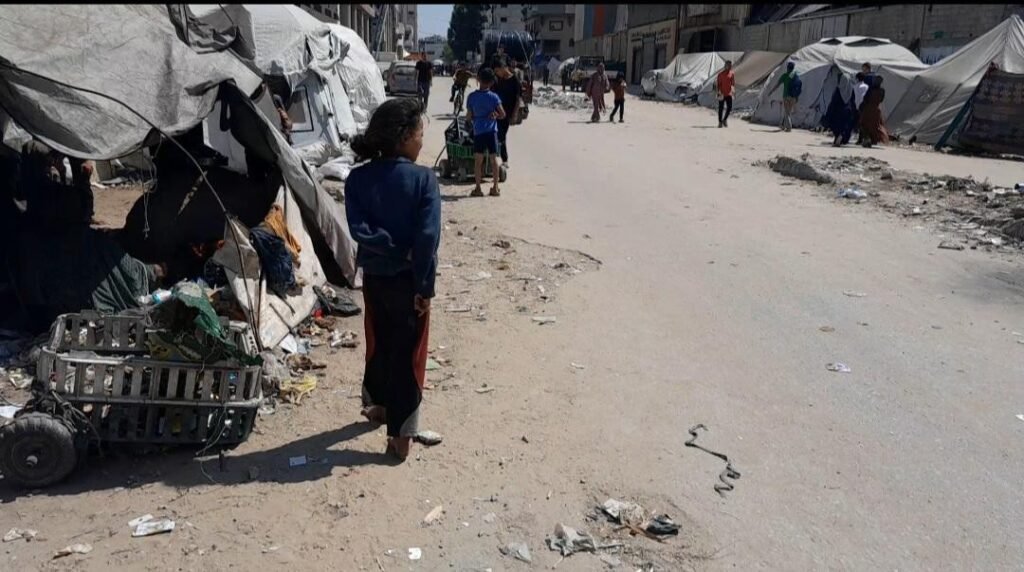
Our office is located in Gaza City, specifically in Al-Nafaq area, close to Jabalia, Al-Sabra, and Al-Tuffah. These are places that are often under evacuation warnings. We frequently hear bombing, shelling, or heavy gunfire.
I will never forget one morning—August 11, 2025. On my way to work, as I approached the camp of displaced families, Israeli drones circled above. Suddenly, they shot a young girl in the head while she was filling a container with water from an aid truck.
I froze. My whole body shook. I whispered the shahada and kept asking myself:“Will I die now, or later?”
People nearby told my colleague Alaa and me to bend low, keep our heads down, and walk close to the wall so we wouldn’t be hit.
Since I started this job, I have never known stability. Because of the distance, I live at my sister’s house in Al-Shati Refugee Camp from Saturday to Wednesday, walking almost an hour each morning to reach work. Every Wednesday, I return to my family in Deir al-Balah, dreaming of rest. I spent Thursday and Friday at home, refusing to leave my room, before starting the journey again.
I told my mother: “I feel like a traveler, carrying my bags and myself through a city that was stolen from us, where even moving between neighborhoods has become a heavy burden.”
Before the genocide, Gaza City was my escape. I ran to it when life became too heavy—walking its streets, watching the sea at dawn, at noon, at dusk, and at night. Now, Gaza is the place that hurts me the most. I don’t hate it—I just hate to see it broken like this.
Even walking to work was painful. My feet ached because there were no smooth roads, only rubble and scattered stones. There were no cars, no transport, nothing to make life easier.
And yet, the hardest part of my work was not the road. It was inside the office, where I met the orphans and their mothers. Their words cut deep into my heart. But my face didn’t show it. Everyone thought I was strong, but inside, I was breaking.
When families begged me for urgent help and I had nothing to offer, I tried to comfort them: “Keep praying… God never forgets anyone. We were with you, but we had nothing at that time.”
Sometimes I had promised that help would come soon, even when I knew it might not. It was all I could offer—words to keep them holding on a little longer. Mothers told me how war had stolen their lives, their peace, even their food. My body shivered. My heart trembled. I whispered: “God willing, it will be better. We won’t forget you. You are not alone.”
There was Samar Al-Ashqar, the only survivor after her parents were killed in an attack. She had lost everything—her father, her mother, her home. There was Hamza Fahjan, who had lost his father. Every year, with the help of his sponsor, we tried to make his birthday special, to remind him he was loved. There was Suha Hamdouna, who had come to register her children as orphans after tanks destroyed her home in 2024, crushing her husband as he held their son. Her boy had survived but stopped speaking altogether. She had come to us straight from the hospital, her back still held with platinum rods. Listening to her had felt like touching death itself.
One day, Nada Abdel-Aal had come to me. She had been displaced from northern Gaza, nine months pregnant, about to give birth. She had stood before me with dignity and asked: “Can you provide a place for me and my orphaned children? Even just a tent?” My heart had ached with helplessness. I had smiled weakly and told her: “We don’t have tents, but I will try to help you personally if I can. Just keep faith in God.” She had known I couldn’t give her what she asked, but she still prayed for me: “May God heal your heart and grant you strength.”
Some of the most heartbreaking times were when I called orphan families to check on them, only to learn that one of the children had been killed. Then began the mother’s long story of loss. In Gaza, I often heard grieving mothers console themselves by saying that martyrs were the lucky ones—released from this unbearable pain. It had been their way of giving meaning to a loss that otherwise felt impossible to carry.
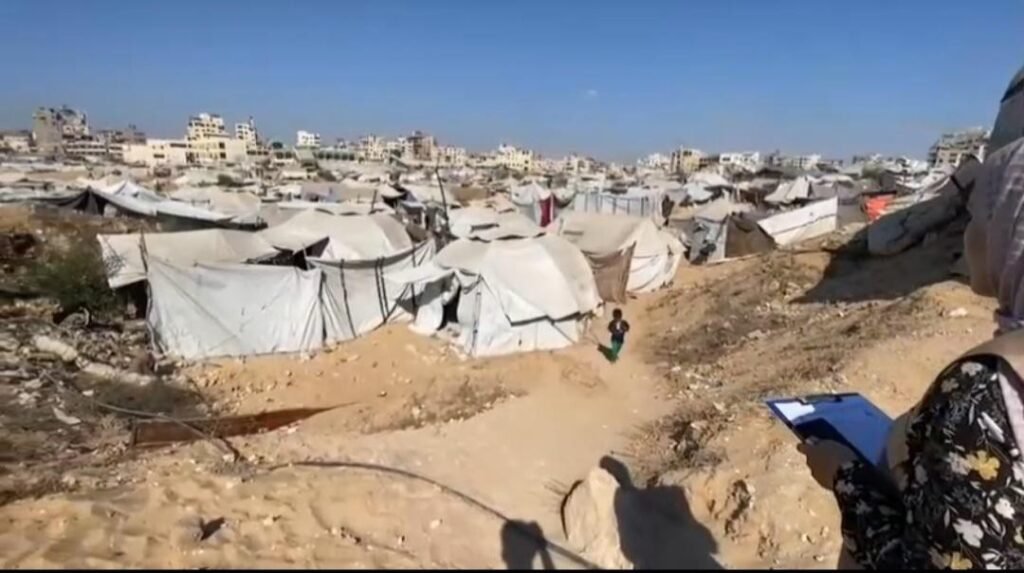
Sometimes, despite my fear, I went down to the camps of displaced families to check on the orphans and see how they were living. Each time, I hesitated before entering the camp, afraid that a random drone strike might hit me. I kept thinking: what if I lost my legs? What if I fell bleeding on the ground with no one able to help? But once I stepped inside, the fear faded. I saw reality as it was: children playing with sand in front of the tents, a clothesline stretched across the middle of the tents, mothers searching for anything to cook, and families who had nothing but the dust beneath them. I listened to their stories and felt utterly helpless. Their pain was stronger than what I could bear, and all I could think was that what we were living through was no longer a life anyone could endure.
And still, there had been rare moments of relief. When our chairman, Jomah Al-Najjar, sat with the orphans, comforted them, and showed kindness, my heart softened. At the end of such days, when I returned to my sister’s home, I felt a little lighter, knowing that—even in small ways—we had managed to ease someone’s pain, even for a short while.
I walked through rubble, carrying my pain quietly, so that I could hold the pain of others without letting it crush me.
But after Gaza City was warned to evacuate in early September, we fled from the city, from our office, from everything we had built. Since then, even the simple act of walking through the rubble of homes and the fractured streets had become a luxury. Gaza City was engulfed in fire, invaded from east to west, its people forced to flee south.
After the ceasefire, everything changed—but not in the way we hoped. The bombs stopped, yes, but the noise stayed inside us. We now work from our homes. The orphanage building was destroyed, along with part of the aid that once kept families alive. We still try to help, but it’s not the same. We no longer see the orphans, no longer feel their hands in ours.
In this strange calm, we’ve gained the luxury to feel our grief—to notice how our lives have shrunk, how even the smallest daily acts have become exhausting. Making tea, finding water, washing clothes—everything takes effort. I look around and see people moving through ruins, pretending this is normal life.
Sometimes I ask myself: Is this what survival means—breathing, working, remembering, but never really living? How do we rebuild when our memories were buried with the buildings? How do we carry on when every step reminds us of what we lost?