

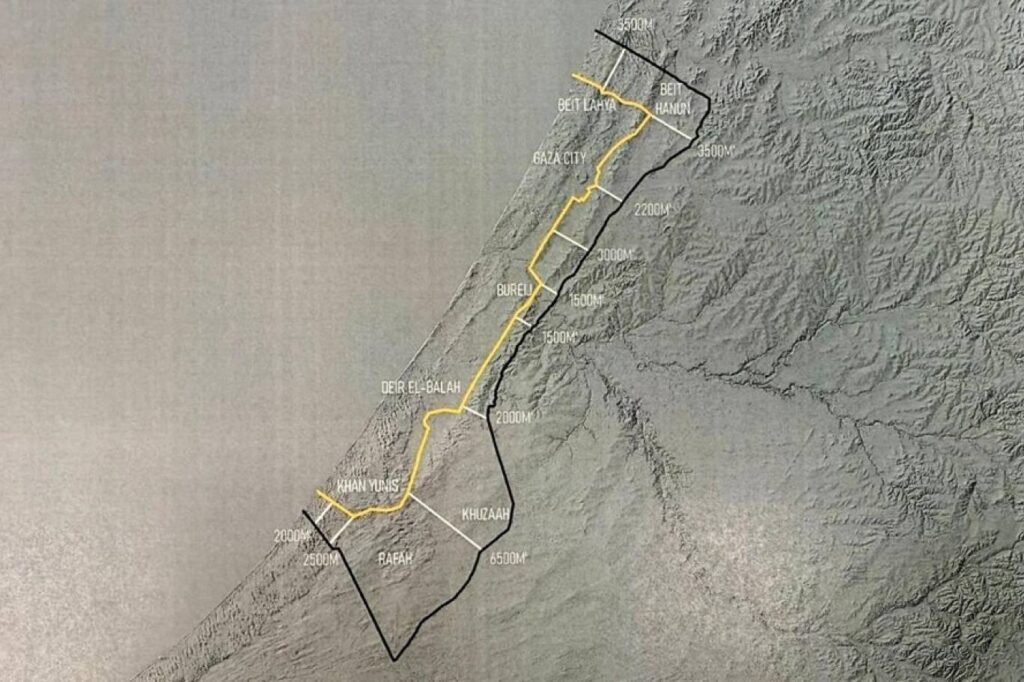
In recent hours, Palestinians in the Jabalia refugee camp were caught off guard by an intense barrage of live fire and shelling, coinciding with the Israeli army’s westward shift of the so-called “yellow line” — a fresh seizure of Palestinian land and a renewed enactment of displacement and forced flight. This move comes as Israel’s control has expanded to encompass around 60 percent of the Gaza Strip to date.
According to local sources, the relocation of concrete blocks and the advancing of the yellow line took place along three axes inside Jabalia camp, pushing as much as one kilometre deep into its narrow alleyways. Jabalia is considered the largest and most densely populated human reservoir of displaced people in Gaza. The operation involved extensive land bulldozing and the installation of massive concrete barriers.
While Palestinian factions have described the move as a fundamental violation of the ceasefire and an attempt to impose new demographic and security realities by force of arms, the Israeli army announced the conclusion of most “sweeping operations” in the area behind the yellow line.
The army’s statement framed this phase as the end of what it termed “disarmament” operations and preparation for a so-called “stabilisation force” phase, expected to begin in the second stage and to include the disarming of Palestinian resistance factions.
Yet the implications of this new Israeli incursion go far beyond military manoeuvres, extending into tangible social and economic consequences for Palestinians. The newly positioned yellow line — which remains liable to further expansion — is set to become a de facto border.
This was previously articulated by Israeli army chief of staff Eyal Zamir, who stated that the yellow line separating Gaza is the Strip’s new border with Israel: an advanced defensive line for settlements and, simultaneously, a line of attack. He stressed that Israeli forces are prepared to remain there for an open-ended period, enabling them to control roughly half of Gaza’s territory and impose new security arrangements on its population.
Among the most severe consequences is the disruption and fragmentation of Palestinians’ daily lives. Residents are being strangled in place and forced once again into displacement, searching for relative safety and areas further removed from frontline zones. The most recent repositioning of the yellow line has already resulted in the targeting of at least 150 Palestinians, including children. One of the most harrowing cases was that of Zaher Shamia, who was killed in a shocking scene after soldiers shot him and then ran him over with a military bulldozer — an incident that sparked widespread outrage among human rights groups, according to UN and rights organisations’ documentation.
The growing confiscation of Palestinian land has also deepened already dire economic and living conditions, depriving people of access to essential services such as water, medicine, and healthcare facilities located near the line.
At the same time, Israel’s determination to expand the line underscores a deliberate push toward the mass displacement of Gaza’s population, by compressing them into ever-smaller areas of land. This is coupled with the deprivation of aid, obstruction of reconstruction efforts, and the continued aerial and border assaults on civilians.
These dynamics further expose the fragility of mediators and the complicity embedded in US sponsorship of the agreement. They reinforce the reality that the occupation operates as a system beyond justice, accountability, and law — one capable of sustaining a climate of perpetual fear and uncertainty for Palestinians. This directly shapes their daily movement and their attempts to reclaim any semblance of normal life after two years of genocide.
Notably, today’s incursion was not the first time the occupation has shifted the yellow line. A previous adjustment took place at the end of last November, alongside the establishment of more than 20 military sites along its length. Some of these sites are equipped with permanent infrastructure, including concrete walls, thermal surveillance towers, and paved roads. By 7 December, the area covered by the line had reached approximately 210 square kilometres — equivalent to 58 percent of the Gaza Strip.
All of this unfolds within a catastrophic humanitarian context, where the suffering of displaced Palestinians has reached levels that UN reports have described as “devoid of prospects and unliveable”. Any expansion of the military zone and the yellow line automatically translates into further suffocation of the already scarce humanitarian corridors. It turns population centres into isolated enclaves governed by fear and threat, while what remains of social and journalistic support networks for families and individuals continues to disintegrate under the weight of repeated displacement.
The expansion of the line has also coincided with escalating Israeli violations of the ceasefire and its core provisions. Since the agreement was signed at the end of last October, Palestinian reports have documented more than 813 violations — an average of 25 per day — resulting by 10 December in the killing of over 400 Palestinians, 95 percent of them civilians, and the destruction of 145 homes. Meanwhile, the Rafah crossing remains closed, preventing patients and humanitarian cases from travelling. Restrictions on the entry of medicines and aid continue to tighten, fuel and gas supplies are manipulated, and demands for information about detainees, missing persons, and the bodies of those killed are ignored.
This scale of violations — coupled with the blind silence of mediators and the United States’ disregard for its role as guarantor of the agreement — unfolds alongside an intensified international drive to close the chapter on genocide in Gaza. The same international community increasingly moves to punish states and peoples who show solidarity with Gaza. Together, these realities leave no room for doubt: the Palestinian in Gaza, abandoned for two years under relentless shelling, will once again be left alone to face displacement, starvation, disease, and cold.
Their land is being used to redraw and entrench Israel’s logic of force in security and military terms. Their reactions are exploited as tools of collective control over Palestinians in the West Bank, inside Israel, and across the wider region. Their continued attrition through bombing and killing is paraded as proof of the absence of any real political horizon, and of the fragility of any binding international guarantees meant to halt violations against them.
In this way, the options left to Palestinians in Gaza — in their search for selfhood and a future — continue to shrink. They are reduced to a brutal choice: to endure the ongoing erosion of their lives and land, or to confront an open-ended annihilation, forced to imagine the future of their grandchildren amid what remains of shifting lines drawn in sand.